Arabic connects everyday conversations with centuries of literature, scholarship, and cultural exchange. Its influence appears in places you might not expect—from the word “zero” to modern internet addresses.
These 38 interesting facts about the Arabic language explore its speakers, history, alphabet, dialects, and grammar. Where a fact concerns Standard Arabic specifically, we make that distinction clear.
01More than 400 million people use Arabic daily
According to UNESCO, more than 400 million people use Arabic every day. Across its different varieties, the language supports conversations, education, entertainment, business, and public life on an enormous scale.
02Arabic has relatives in the Semitic language family
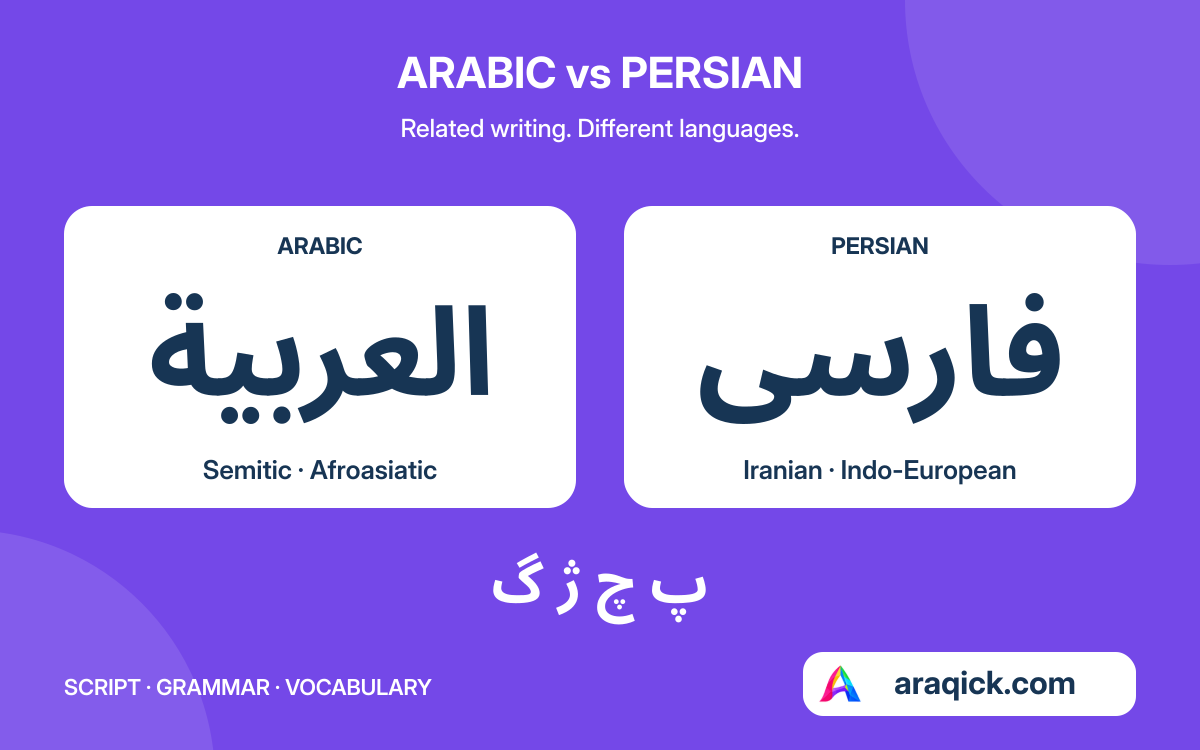
Arabic belongs to the same language family as Hebrew, Aramaic, and Amharic. These languages share historical connections and certain structural features, although knowing one does not automatically mean understanding the others.
03Arabic’s native-speaking region spans Africa and Asia
Arabic is spoken natively across a broad region that includes North Africa, the Arabian Peninsula, and other parts of Western Asia. Countries such as Morocco, Egypt, Saudi Arabia, and Iraq illustrate this geographical reach.
04Arabic is one of the UN’s six official languages
Arabic stands alongside Chinese, English, French, Russian, and Spanish as an official language of the United Nations. This gives it an established role in international diplomacy and the organisation’s multilingual communication.
05Arabic gained official status in the UN General Assembly in 1973
On 18 December 1973, the United Nations General Assembly adopted Resolution 3190. The decision included Arabic among the official and working languages of the General Assembly and its main committees—a major milestone in its international recognition.
06Arabic has its own international celebration day
World Arabic Language Day takes place on 18 December each year. The date commemorates the UN’s 1973 decision and provides an occasion to celebrate Arabic’s history, literature, cultural diversity, and contributions to knowledge.
07Arabic has been used by communities of different faiths
Muslim, Christian, and Jewish communities have spoken and written Arabic over the centuries. Their contributions include religious works, literature, scholarship, correspondence, and everyday records, reflecting the language’s place within different cultural traditions.
08Arabic is the original language of the Quran
The Quran’s original text is in Arabic. This gives the language religious significance for Muslims around the world, including many whose first language is different. Studying Arabic can help readers engage directly with the text’s vocabulary and expression.
09Arabic existed before Islam
Arabic’s history extends into the pre-Islamic period. Inscriptions preserve evidence of early forms of the language, allowing researchers to investigate how people expressed themselves before the emergence of Islam in the seventh century.
10Arabic became a major language of medieval science
Scholars used Arabic to write about medicine, astronomy, mathematics, and other fields. It served both as a language of translation and as a medium for original scholarship, allowing ideas to circulate among people from different backgrounds.
11Early Arabic manuscripts used dots differently
Some early Arabic manuscripts used letter-distinguishing dots sparingly or inconsistently. Modern writing marks these distinctions much more systematically. For example, ب, ت, and ث share a basic shape but are distinguished by their dots.
12Modern Standard Arabic and Classical Arabic share much of their grammar
Modern Standard Arabic retains much of the grammatical structure associated with Classical Arabic. Differences are especially noticeable in vocabulary, style, and subject matter, as modern writers discuss everything from journalism to computing and contemporary science.
14One country can contain several Arabic dialects
Arabic does not have one uniform spoken variety within every country. Pronunciation, vocabulary, and expressions can vary between regions and communities. Dialect boundaries also do not always line up neatly with national borders.
15Everyday dialects generally omit Standard Arabic’s full case-ending system
Standard Arabic uses grammatical endings to mark certain relationships between words. Everyday dialects generally do not preserve this complete noun case-ending system. This is one reason a formal written sentence can sound different from ordinary conversation.
16Arabic dialects carry traces of language contact
Arabic dialects include words borrowed from languages such as Turkish, French, and Persian. The influence varies by region and reflects histories of trade, migration, government, and cultural exchange. Different communities therefore carry different linguistic connections in their everyday vocabulary.
17The Arabic alphabet has 28 basic letters
The Arabic alphabet is conventionally taught as a set of 28 basic letters. Learning these letters gives beginners the foundation for recognising written words, even though many letters change their appearance when connected to others.
18Arabic text runs from right to left
A line of Arabic begins on the right and progresses towards the left. When Arabic appears alongside English or numerals, a single line can contain elements with different reading directions—a normal feature of mixed-language text.
19Arabic has no capital letters
Arabic does not distinguish between uppercase and lowercase letters. Names and sentence beginnings use the same alphabet as other words. Changes in a letter’s shape relate to its written context rather than to capitalisation.
20Standard Arabic has three basic short vowel qualities
The three basic short vowels are a, i, and u. Their familiar written marks are fatha, kasra, and damma. For example, بَ, بِ, and بُ represent the same consonant with three different short vowels.
21Most everyday Arabic writing leaves out short vowel marks
Newspapers, messages, and many books normally omit most short vowel marks. Readers use vocabulary, word patterns, grammar, and context to identify the intended pronunciation. Educational materials often include more marks to support learners.
22Arabic nouns have grammatical gender
Arabic nouns are classified as masculine or feminine. This classification affects how other words, including adjectives, agree with them. Grammatical gender also applies to objects and ideas: شَمْس, “sun,” is feminine, while قَمَر, “moon,” is masculine.
23Standard Arabic has three noun cases
The three noun cases are nominative, accusative, and genitive. They help indicate a noun’s grammatical role or relationship to other words. Their endings are particularly noticeable in fully vowelled texts and careful formal pronunciation.
24Standard Arabic has no separate word equivalent to “a” or “an”
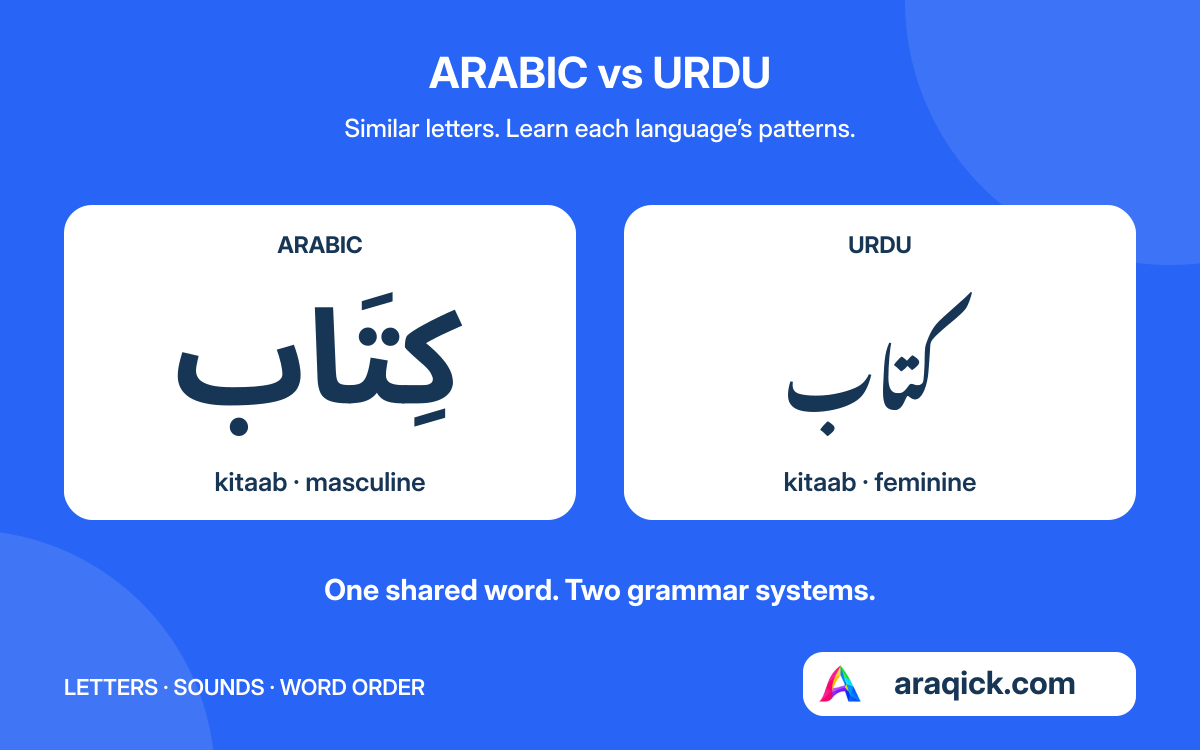
English uses “a” and “an” before many indefinite singular nouns. Standard Arabic does not use a separate indefinite article in the same way. For example, كِتَابٌ can mean “a book” without an additional word before it.
25Traditional Arabic grammar recognises nominal and verbal sentences
Traditional grammar distinguishes nominal sentences, الجملة الاسمية, and verbal sentences, الجملة الفعلية. A basic nominal sentence presents a subject and information about it, while a basic verbal sentence begins with a verb. These are two important ways of organising a statement.
26Arabic sentences can begin with a verb or a subject
Both قَرَأَ الطَّالِبُ الْكِتَابَ and الطَّالِبُ قَرَأَ الْكِتَابَ can express “The student read the book.” The first begins with the verb; the second begins with the subject. Word order can affect emphasis and, in some constructions, agreement.
27Standard Arabic has several forms of “you”
English uses “you” for one person or several people. Standard Arabic makes more distinctions. أَنْتَ addresses one male, أَنْتِ addresses one female, and أَنْتُمَا addresses two people. There are also separate masculine and feminine plural forms.
28Arabic contexts use more than one set of digit shapes
Both 0123456789 and ٠١٢٣٤٥٦٧٨٩ appear in Arabic contexts. Their use varies by region, publication, and setting. The shapes differ, but they represent the same numerical values: 123 and ١٢٣ are the same number.
29Numbers keep their place-value order inside Arabic text
Although Arabic words run from right to left, numerals place the highest-value digit on the left. In ١٢٣, the hundreds digit comes first on the left and the units digit appears on the right, just as in 123.
30Arabic scholarship helped bring the decimal numeral system to Europe
The Hindu-Arabic decimal numeral system developed in India and reached Europe through transmission that included the Arabic-speaking world. Arabic mathematical writing helped spread knowledge of the system, connecting the histories of Indian, Arabic-language, and European scholarship.
31“Algorithm” preserves the name of al-Khwarizmi
The English word “algorithm” developed from a Latinised form of the name al-Khwarizmi, a mathematician whose works included Arabic texts. A term now closely associated with computers therefore carries a connection to medieval mathematical scholarship.
32English “zero” has an Arabic connection
The word “zero” traces back through European languages to Arabic صِفْر, meaning zero. Its journey is a reminder that familiar mathematical vocabulary can preserve traces of contact between languages over many centuries.
33Arabic has also been written in Hebrew letters
Judeo-Arabic manuscripts provide examples of Arabic written using Hebrew letters. Documents preserved in the Cairo Genizah include this tradition. They demonstrate that a language and the script used to write it are two different things.
34Urdu uses a related script but belongs to another language family
Urdu is commonly written in a Perso-Arabic script, often in the Nastaliq style. Linguistically, however, it belongs to the Indo-Aryan branch of the Indo-European family. Sharing a script does not make Urdu a variety of Arabic.
35Ottoman Turkish used an Arabic-based script
Ottoman Turkish was written using an adapted Arabic-based writing system. Modern Turkish uses a Latin-based alphabet. Historical Ottoman books and documents therefore look very different from modern Turkish publications, even before a reader considers changes in vocabulary.
36Arabic books usually open from the opposite side to English books
Arabic books are typically bound on the right, with pages progressing from right to left. For someone accustomed to English books, the front cover may initially seem to be on the other side. This arrangement follows the language’s reading direction.
37Computers choose the appropriate shape of an Arabic letter
In normal Unicode text, an Arabic letter is stored independently of its contextual appearance. Text-rendering software uses the surrounding letters and font to display the appropriate form, helping connected Arabic text appear correctly on screens.
38Internet addresses can use Arabic script
Domain names can be written in Arabic script, including their endings. Arabic country-code domain endings entered the internet’s root system in 2010. Examples include Egypt’s مصر ending, allowing addresses that use Arabic throughout the domain name.
Keep exploring Arabic
The next time you open an Arabic book, recognise a familiar word, or read a number inside Arabic text, you may notice a detail you previously overlooked.
Continue exploring Arabic words, grammar, and everyday expressions with Araqick—and build on your curiosity with Learn Arabic A1.
Sources & further learning
References for the language explanations and learning guidance.
- UNESCO: World Arabic Language Day
- United Nations: Official languages
- UN General Assembly: Resolution 3190 (XXVIII)
- Georgetown University: Arabic as a Foreign Language
- Cambridge University Press: Introduction to Arabic
- Ohio State University: Research on an ancient variety of Arabic
- Qatar Digital Library: Hunayn ibn Ishaq and Arabic-language science
- The Metropolitan Museum of Art: Early Quran manuscript
- Richard Ishida: Arabic orthography notes
- W3C: Arabic and Persian Layout Requirements
- Madinah Arabic: Nominal and verbal sentences
- Madinah Arabic: Arabic pronouns
- University of St Andrews: The Arabic numeral system
- Merriam-Webster: Algorithm word history
- Merriam-Webster: Zero word history
- Cambridge University Library: Genizah Fragments
- University of Pennsylvania: Urdu language
- Library of Congress: Learn Ottoman Turkish
- Unicode Standard: Arabic script and contextual shaping
- ICANN: First internationalized country-code top-level domains