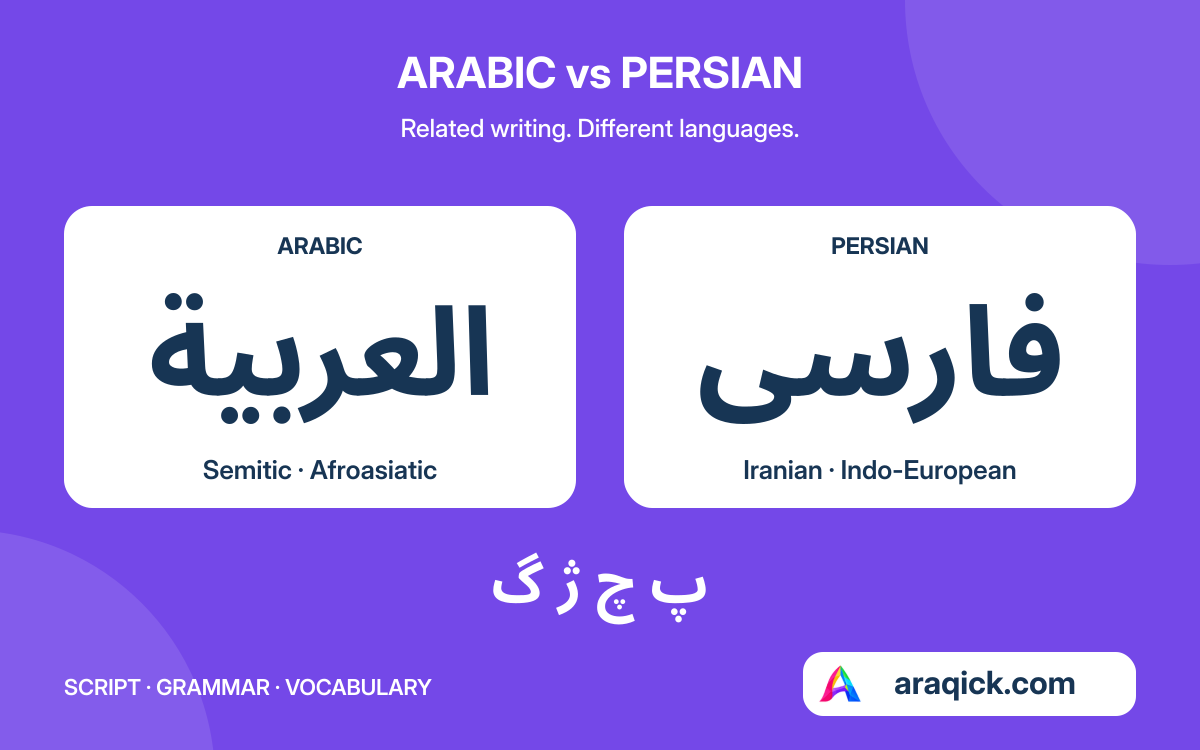
Arabic and Persian are different languages, although their writing systems share many letters. Arabic belongs to the Semitic branch of Afroasiatic; Persian belongs to the Iranian branch of Indo-European. Persian has borrowed many Arabic words, but it keeps its own sounds and grammar. This guide compares Modern Standard Arabic (MSA) with standard Iranian Persian.
01Are Arabic and Persian the same language?
No. A writing system is a way to record a language; a language family describes historical relationships. Persian is not a dialect of Arabic. Knowing one may help you recognise some writing in the other, but it does not make an unfamiliar sentence understandable.
Farsi is the Persian name for Persian. Related varieties include Dari and Tajik; modern Tajik normally uses Cyrillic. The script examples here use Iranian Persian.
02Why do the scripts look similar?
Both run from right to left and use joining letters. The usual teaching count is 28 Arabic letters and 32 Persian letters. Persian adds four letters to the Arabic-based alphabet:
| Letter | Usual sound |
|---|---|
| پ | p |
| چ | ch |
| ژ | zh, like the middle sound in measure |
| گ | g, as in go |
Persian also uses its own common forms ک ی for kaf and ye. A change in letter shape or font alone does not identify a whole language.
03Do shared letters always sound alike?
No. In standard Iranian Persian, several historically different Arabic letters have merged in pronunciation. For example, ث س ص generally represent s, while MSA distinguishes their sounds. Persian و can represent v where Arabic uses w.
Arabic
كِتَاب
kitaab
Book
Persian
کتاب
ketaab
Book
The borrowed word is recognisable, but its first vowel differs in these standard pronunciations.
04How does sentence order differ?
MSA · subject, verb, object
أَنَا أَقْرَأُ كِتَابًا
ana aqrau kitaaban
I read a book.
Persian · subject, object, verb
من کتاب میخوانم
man ketaab mikhaanam
I read a book.
The Persian verb comes at the end in this neutral example. MSA commonly permits both subject-first and verb-first verbal sentences. These are useful starting patterns, not rules that forbid every other order.
05Does Persian have Arabic-style gender?
Modern Persian has no grammatical masculine/feminine noun classes. The pronoun او (u) can mean he or she. MSA distinguishes هُوَ (huwa, he) and هِيَ (hiya, she), and its nouns have grammatical gender.
MSA also has dedicated dual forms, such as كِتَابَانِ (kitaabaani, two books). Persian does not share this Arabic dual system. Avoid transferring Arabic agreement endings into Persian.
06How much vocabulary can I recognise?
Arabic borrowing gives Persian many familiar-looking words, including کتاب (ketaab, book) and قلم (qalam, pen). Other everyday words differ: Arabic مَاء (maa, water) corresponds to Persian آب (aab).
Borrowing does not make the languages mutually intelligible. Learn a shared word with its local pronunciation, meaning and sentence. Do not assume that every meaning of the Arabic word survives in Persian.
07How should an Arabic learner use the comparison?
Compare one feature at a time: letter, sound, word, then sentence. Start with “book,” say both pronunciations, and locate the verb in the two reading examples. This builds useful recognition without mixing their rules.
Review the Arabic alphabet, Arabic noun gender and Arabic–Urdu comparison. The reference shelf keeps the main differences together.
What to remember
- Arabic and Persian belong to different language families.
- Related scripts and borrowed words are useful clues, not automatic translation.
- Compare standard pronunciations and sentence patterns separately.
Your reference shelf
Open a guide whenever you need it.
Arabic and Persian at a glanceA compact comparison of the varieties used in this guide.
| Feature | Modern Standard Arabic | Standard Iranian Persian |
|---|---|---|
| Family | Semitic, Afroasiatic | Iranian, Indo-European |
| Usual alphabet count | 28 letters | 32 letters |
| Text direction | Right to left | Right to left |
| Useful neutral verbal pattern | Subject–verb–object or verb–subject–object | Subject–object–verb |
| Grammatical gender | Masculine and feminine | No grammatical noun gender |
| He / she | هُوَ / هِيَ | او |
| Book | كِتَاب · kitaab | کتاب · ketaab |
| Water | مَاء · maa | آب · aab |
Sources & further learning
References for the language explanations and learning guidance.