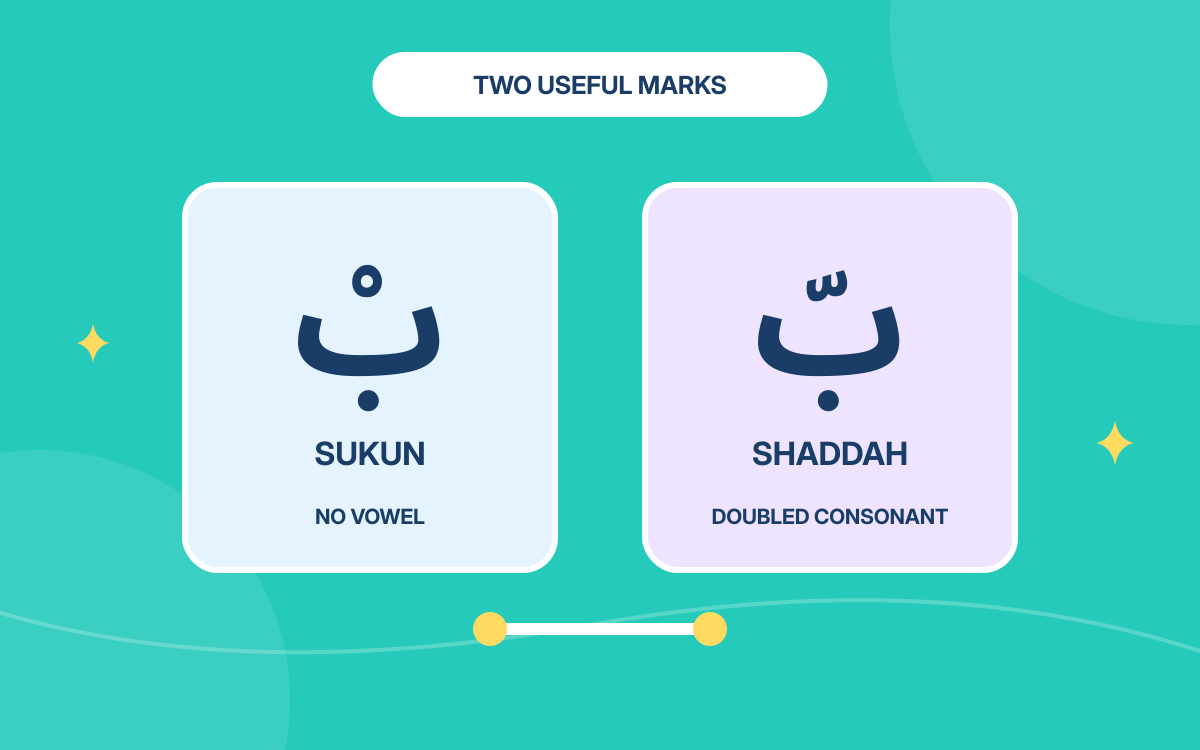
Sukun and shaddah answer different reading questions. Sukun tells you that a consonant has no following vowel. Shaddah tells you that the consonant is doubled. Keep both distinctions: a consonant without a vowel is still pronounced, and a doubled consonant is more than a louder single sound.
01Sukun means no following vowel
مِنْ
min
From
The small circle above nun is sukun. Read mi, then n: min. The n remains audible, but there is no a, i or u after it. Do not turn the word into mina when reading this isolated form.
Sukun describes the vowel after a consonant. It does not tell you to erase that consonant.
02Look inside a longer word
مَكْتَب
maktab
Desk / office
The kaf has sukun. Join mak directly to tab: maktab. Inserting an extra vowel after k would change the sound pattern. This vocabulary card uses a pause form without a final case ending.
By contrast, an unmarked letter in ordinary writing is not automatically a letter with sukun. Texts can leave out several kinds of reading marks. In this lesson, a visible sukun gives you definite information about the marked consonant.
03Shaddah doubles a consonant
darasa
He studied
darrasa
He taught
The small w-shaped mark above ra is shaddah. Darrasa contains a doubled r. There is no extra vowel between the two consonant parts: do not read dararasa.
The contrast matters to meaning. Our first word describes studying; our second describes teaching. Doubling does not automatically make every verb mean teaching, and adding shaddah anywhere does not produce a valid word. Learn the actual word along with its sound pattern.
04Read shaddah and the vowel together
دَرَّسَ خَالِدٌ
darrasa khalidun
Khalid taught.
In رَّ, shaddah supplies the doubled r and fathah supplies the following a. They do separate jobs. Shaddah is not itself the vowel a, i or u.
A doubled consonant can also remain at the end of a word. At a pause, أُمّ umm, mother, still ends with a doubled m. Dropping a final grammatical vowel does not turn umm into um. Full noun endings are shown only where they are part of the example.
05Use the marks to check yourself
- Sukun: keep the consonant; add no vowel after it.
- Shaddah: pronounce a doubled consonant with no vowel inserted between its parts.
- Vowel mark: read the vowel shown alongside the consonant or shaddah.
Try min, maktab, darasa and darrasa slowly, then read them at a comfortable pace. Keep the r contrast clear even when you speed up. Changing loudness alone will not create the doubled sound.
The article before a sun letter is another place you meet shaddah, such as the doubled sh in الشَّمْس. Our sun and moon letters guide explains that separate pattern. Here, focus on recognising what the mark asks you to pronounce.
What to remember
- Sukun means no vowel after the consonant; the consonant remains.
- Shaddah marks doubling, which can distinguish words such as darasa and darrasa.
- Read any accompanying vowel separately; do not insert one inside the doubled consonant.
Your reference shelf
Open a guide whenever you need it.
Compare the marks and examplesOpen a compact reading reference
| Arabic | Reading aid | Meaning or use |
|---|---|---|
| مِنْ | min | Nun has no following vowel in this isolated form |
| مَكْتَب | maktab | Kaf has no following vowel; pause form |
| دَرَسَ | darasa | Single r: he studied |
| دَرَّسَ | darrasa | Doubled r: he taught |
| أُمّ | umm | Doubled final m, also when pausing |
Are sukun and shaddah interchangeable? No. They encode different features.
Can pronunciation change when words join? Yes. For example, the isolated preposition مِنْ can become مِنَ before the definite article, as in مِنَ الْبَيْتِ. That connected-speech pattern does not change how you read the isolated min card.
Is every unmarked letter vowelless? No. Ordinary spelling often omits marks, so you still need vocabulary and context.
Sources & further learning
References for the language explanations and learning guidance.