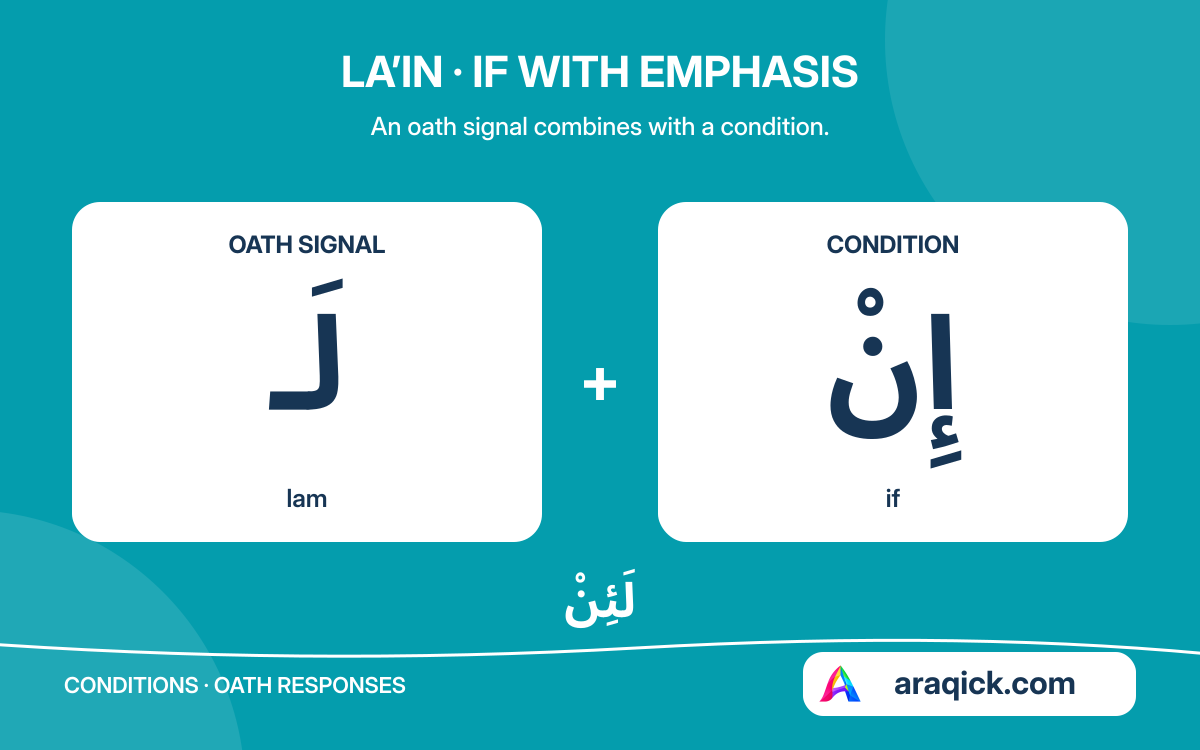
La’in combines a condition with the force of an oath. Its in means if, while the prefixed lam signals an oath understood before that condition. The following answer therefore follows an oath-response pattern. This explains why a sentence can look conditional but lack the fa you expected.
01Find the condition inside la’in
لَئِنْ أَرْسَلْتَ الْمِلَفَّ لَأُرَاجِعَنَّهُ
lain arsalta almilaffa laurajiannahu
If you send the file, I will certainly review it.
The prefixed lam signals an understood oath; in introduces the condition. Arsalta almilaffa means if you send the file in this context. Although arsalta has past-tense form, the condition concerns a possible future action.
The final clause promises a review with lam and heavy nun. The suffix hu refers back to the file. A natural English translation may convey the oath’s force through certainly without inserting a separate I swear.
02Review an ordinary nominal conditional answer
إِنْ سَأَلْتَنِي فَإِنِّي مُسْتَعِدٌّ
in saaltani fainni mustaiddun
If you ask me, I am ready.
This sentence starts with plain conditional in. Its answer is a nominal clause introduced by inna, so fa connects that answer to the condition. The ending ni on saaltani means me.
The fa is required by this answer structure; it is not just an English-style then that can always be removed. Review fa in conditional answers before comparing the oath pattern.
03Recognize the oath answer without that fa
لَئِنْ سَأَلْتَنِي إِنِّي لَمُسْتَعِدٌّ
lain saaltani inni lamustaiddun
If you ask me, I am certainly ready.
The lam in la’in signals an oath preceding the condition in the understood structure. In this model, inni lamustaiddun is the oath response, so it does not use the conditional connecting fa from the previous example.
Traditional analysis treats the separate conditional answer as omitted because the oath response supplies its meaning. This lesson covers the la’in pattern with the oath understood first. Do not generalize the rule to every possible ordering of oaths and conditions.
04Let the answer keep its own polarity
لَئِنْ سَأَلْتَنِي لَا أُخْفِي الْحَقِيقَةَ
lain saaltani la ukhfi alhaqiqata
If you ask me, I will not hide the truth.
La’in does not require every answer to be an affirmative promise. Here the oath response is negative, beginning with la. Do not force the affirmative lam-plus-nun pattern onto it.
The negative particle belongs to the response, not to the condition. The speaker makes an emphatic assurance about what will not happen if asked. Compare the positive and negative patterns in jawab al-qasam.
05Keep la’in, li’anna and lan apart
لَئِنْ تَسْأَلْنِي لَأُجِيبَنَّكَ
lain tasalni laujibannaka
If you ask me, I will certainly answer you.
In this example the condition uses a present-form verb. Conditional in makes tasalni jussive, with sukun on the final root consonant lam before the object suffix ni. The following answer has its own emphatic construction.
La’in means if with an oath signalled; لِأَنَّ means because, and لَنْ introduces a future negative. Similar letters do not make their functions interchangeable. Plain reading aids simplify hamzah and vowel length; use the Arabic spelling and sentence role to identify the particle.
What to remember
- La’in contains an oath-signalling lam and conditional in.
- In this pattern the expressed oath response also supplies the condition’s answer.
- Do not remove fa from ordinary nominal conditional answers or confuse la’in with li’anna.
Your reference shelf
Open a guide whenever you need it.
Read the file example in layersEach part has a different job
| Part | Arabic | Function |
|---|---|---|
| Oath signal | لَـ | Signals an oath understood before the condition |
| Condition particle | إِنْ | If; combines with lam as لَئِنْ |
| Condition | أَرْسَلْتَ الْمِلَفَّ | You send the file |
| Oath response | لَأُرَاجِعَنَّهُ | I will certainly review it |
| Object suffix | ـهُ | It, referring to the file |
Ordinary condition versus the la’in modelChoose the answer structure after identifying the opening
| Opening and condition | Answer | Analysis |
|---|---|---|
| إِنْ سَأَلْتَنِي | فَإِنِّي مُسْتَعِدٌّ | Ordinary nominal conditional answer: fa connects it |
| لَئِنْ سَأَلْتَنِي | إِنِّي لَمُسْتَعِدٌّ | Nominal oath response: no conditional fa here |
| لَئِنْ أَرْسَلْتَ الْمِلَفَّ | لَأُرَاجِعَنَّهُ | Affirmative future oath response |
| لَئِنْ سَأَلْتَنِي | لَا أُخْفِي الْحَقِيقَةَ | Negative oath response |
This comparison concerns the oath-first structure signalled by la’in; it is not a rule for every arrangement of a condition and an oath.
Sources & further learning
References for the language explanations and learning guidance.