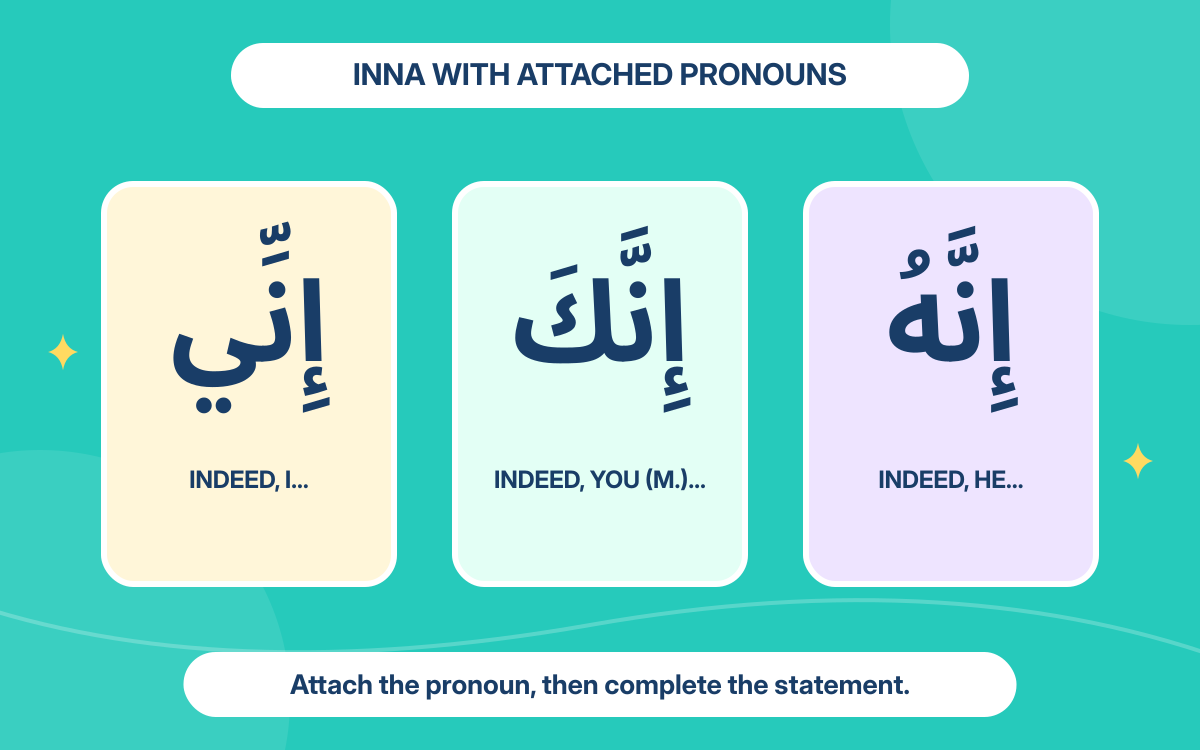
When the noun of inna is a person expressed by a pronoun, attach that pronoun to the particle. Innahu introduces he; innaka addresses one man; inni introduces I. The attached form identifies the person, and the predicate still gives the information.
01Talk about him or her
For a simple “he is” or “she is” statement with inna, use the attached forms innahu and innaha. The suffix supplies the noun of inna.
إِنَّهُ طَالِبٌ
innahu talibun
Indeed, he is a student.
إِنَّهَا طَالِبَةٌ
innaha talibatun
Indeed, she is a student.
Talibun is masculine; talibatun is feminine. Both predicates are nominative. “Indeed” makes the emphasis visible here, though natural English may express it through stress instead.
02Address one man or one woman
Innaka addresses one male listener. Innaki addresses one female listener. The short vowel on the final k changes the addressee.
إِنَّكَ طَالِبٌ
innaka talibun
Indeed, you are a student. — one man
إِنَّكِ طَالِبَةٌ
innaki talibatun
Indeed, you are a student. — one woman
Do not replace innaka with innahu when you are speaking directly to the person. That would change “you” to “he.”
03Use either form for I
Inni and innani both introduce I. The longer form includes an additional n before the first-person suffix; both are standard.
إِنِّي طَالِبٌ
inni talibun
Indeed, I am a student. — a male speaker
إِنَّنِي طَالِبَةٌ
innani talibatun
Indeed, I am a student. — a female speaker
Either inni or innani works for either speaker. The predicate, not the I suffix, changes for gender. Inni has a long final i; our plain reading aid simplifies vowel length.
04Include yourself or discuss a group
Use innana for we, innahum for a male or mixed human group, and innahunna for a female group. We works for any group including the speaker.
إِنَّنَا طُلَّابٌ
innana tullabun
Indeed, we are students. — a male or mixed group
إِنَّهُنَّ طَالِبَاتٌ
innahunna talibatun
Indeed, they are students. — a female group
The shorter إِنَّا (inna) also means “indeed, we.” Its long final a, written with alif, distinguishes it from the plain particle إِنَّ, with short final a.
05Recognise the role without changing the suffix
The attached pronoun is fixed in form and occupies the accusative position of inna’s noun. It does not receive a new fathah. The simple predicate still has its nominative ending.
إِنَّهَا مُدَرِّسَةٌ
innaha mudarrisatun
Indeed, she is a teacher.
Ha refers to she; it does not mean “her teacher” in this construction. Mudarrisatun is the information about her. Build the attached form first, then add the predicate.
What to remember
- Attach the pronoun directly to inna: innahu, innaha, innaka and innaki.
- Inni and innani both mean indeed I; innana and إِنَّا both mean indeed we.
- The pronoun occupies an accusative position, while the simple predicate stays nominative.
Your reference shelf
Open a guide whenever you need it.
Keep the attached forms nearbyCheck I, you, he, she, we and the group forms
| Role or pattern | Arabic | Reading |
|---|---|---|
| I — either gender | إِنِّي / إِنَّنِي | inni / innani |
| We — any gender | إِنَّنَا / إِنَّا | innana / inna |
| You — one man | إِنَّكَ | innaka |
| You — one woman | إِنَّكِ | innaki |
| You — two people | إِنَّكُمَا | innakuma |
| You — male or mixed group | إِنَّكُمْ | innakum |
| You — female group | إِنَّكُنَّ | innakunna |
| He | إِنَّهُ | innahu |
| She | إِنَّهَا | innaha |
| They — two people | إِنَّهُمَا | innahuma |
| They — male or mixed group | إِنَّهُمْ | innahum |
| They — female group | إِنَّهُنَّ | innahunna |
The dual suffixes work for either gender; the predicate supplies the appropriate gender and number. A feminine we group can use innana talibatun. Keep vowel length visible in the Arabic: إِنَّ is the particle alone, while إِنَّا includes we. A separate pronoun can occur for added emphasis, but it is not required in these simple statements.
Sources & further learning
References for the language explanations and learning guidance.