Improve Arabic listening by working actively with a short, understandable recording: listen for the situation, listen again for a few details, check a reliable transcript, then replay without it. Choose Modern Standard Arabic or a spoken variety that fits your goal. The sample routine below takes 15 minutes, but it is a practical schedule to adapt, not a promise of fluency in a fixed period.
01Choose one useful recording
Start with a short exchange about something familiar, such as a greeting, a shop or a meeting time. A clip of roughly 30–60 seconds can be a manageable first experiment; shorten it further if necessary. Look for clear audio and a matching transcript.
Choose the relevant variety. An MSA news report and a casual Egyptian conversation train overlapping but different expectations. Use our variety guide to connect the recording to your goal.
02Listen once for the situation
Before playing, set one broad question: who is speaking, where are they, or what do they want? Listen without stopping at each unfamiliar word. Write one tentative answer, even if it is incomplete.
Do not use the transcript to supply this first answer. Missing some details is useful information about what to revisit; it does not mean the entire attempt failed. If you cannot identify even a basic situation after trying, choose an easier recording.
03Listen again for two details
Pick two details appropriate to the clip: a price and an item, a day and a time, or a destination and a request. Replay the relevant part and note what you actually hear. Keep guesses separate from confident answers.
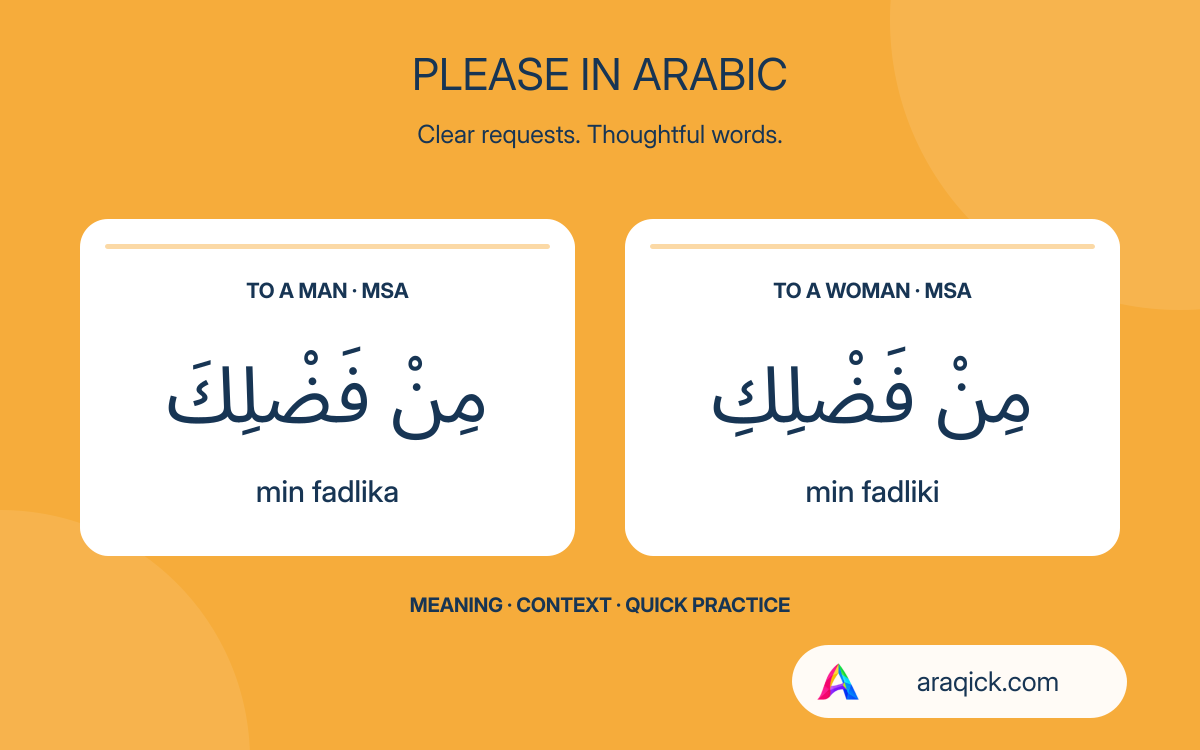
If a detail is unclear, replay that short segment rather than restarting a long episode repeatedly. In conversation, use a clarification request such as مِنْ فَضْلِكَ، أَعِدْ ذَلِكَ. (min fadlika, aid dhalik), “Please repeat that,” addressed to a man.
04Compare sound with the transcript
Now read the matching transcript while listening. Mark the exact point you missed. Was the word unknown, familiar on paper but unfamiliar in speech, or joined so closely to another word that you missed the boundary? These call for different practice.
Check an unknown word in context. For a familiar word, replay its phrase and connect the written form to the sound. English translation helps with meaning, but an Arabic transcript also helps you inspect what was actually said.
05Remove the text and listen again
Hide the transcript, replay the same section, and answer the two detail questions again. Then summarise the message in one plain sentence. Compare with your first attempt and note what became clearer.
You may slow a recording temporarily if the player allows it, then return to its original speed. Repeat one short phrase after understanding it. Echoing sounds is useful practice, but successful imitation alone does not prove that you understood the message.
06Give a short session a clear shape
Try the 15-minute schedule on the reference shelf. Spend a little time choosing a task, then make separate passes for situation, details, transcript checking and unsupported replay. Finish with one note about the next session.
The timing is flexible. If the recording is too difficult, reduce its length or choose an easier one. At a later session, replay it once without text before moving to a new speaker or a new example of the same task.
07Track understanding rather than hours alone
Record one observable result: “I identified the meeting day without reading,” or “I heard the request but missed the number.” Revisit that skill with a new, suitable recording so that improvement is not only memory of one clip.
Araqick’s written dialogues and stories support reading and vocabulary preparation. A written passage is not itself a recording: use an appropriate audio source with its actual transcript for the listening passes. For polite clarification, practise requests too.
What to remember
- Choose relevant short audio and give each listening pass a clear task.
- Use the transcript to diagnose a missed segment, then hide it for a listening check.
- Measure specific understanding and transfer it to new suitable recordings.
Your reference shelf
Open a guide whenever you need it.
A sample 15-minute listening sessionThese timings total 15 minutes; adjust them to the clip and your attention.
| Time | Task | What to record |
|---|---|---|
| 2 minutes | Choose a short recording and one broad question | The variety, topic and first task |
| 3 minutes | Listen for the situation, then choose two details | A tentative summary and detail questions |
| 3 minutes | Replay the relevant parts for those details | What you heard, with guesses marked |
| 3 minutes | Check the Arabic transcript while listening | One unknown word or missed sound boundary |
| 2 minutes | Hide the text and replay | The two answers from audio alone |
| 2 minutes | Summarise and plan the next revisit | One specific result and next step |
What made that segment difficult?Use the difficulty to choose a small next action.
| What happened | Try next | Avoid assuming |
|---|---|---|
| The word was unknown | Check its meaning in the sentence, then replay | That more speed practice alone will teach its meaning |
| The word was familiar only in writing | Compare its written form with the recorded phrase | That reading recognition already guarantees listening recognition |
| Two words sounded like one | Replay a short phrase and locate the boundary | That every speaker pauses between written words |
| The variety was unfamiliar | Choose a relevant model and compare a few labelled forms | That all regional forms match MSA |
| One memorised clip became easy | Try another suitable speaker or example of the same task | That remembering one clip proves general comprehension |
Reading, translation and sound do different jobsUse a transcript that matches the recording rather than an unrelated written version.
| Resource | What it helps you check | Limitation |
|---|---|---|
| The actual recording | Pronunciation, rhythm and the spoken message | It may be too difficult without suitable support. |
| A matching Arabic transcript | The words actually present in the recording | Reading it can hide what you missed by ear. |
| An English translation | The intended message and unfamiliar meanings | It does not show every Arabic sound or word boundary. |
| A written Araqick dialogue or story | Vocabulary and reading preparation | Text alone does not supply a recording. |
Sources & further learning
References for the language explanations and learning guidance.