Arabic and Hebrew are related Semitic languages with different alphabets. They share root-and-pattern word building and several familiar-looking words, but their sounds, grammar and vocabulary differ. This guide compares Modern Standard Arabic (MSA) with Modern Hebrew. Shared ancestry can help a learner notice patterns; it does not make an unfamiliar conversation automatically understandable.
01Are Arabic and Hebrew the same language?
No. They are different languages within the Semitic family. Calling them related describes historical connections, rather than saying that one is a modern version or a dialect of the other. Each has its own history and present-day communities.
The comparison also needs a variety label. MSA is used in formal Arabic contexts, while regional Arabic speech has its own features. Modern Hebrew and Biblical Hebrew are related historical stages, not interchangeable labels for every text or pronunciation.
02How do the alphabets differ?
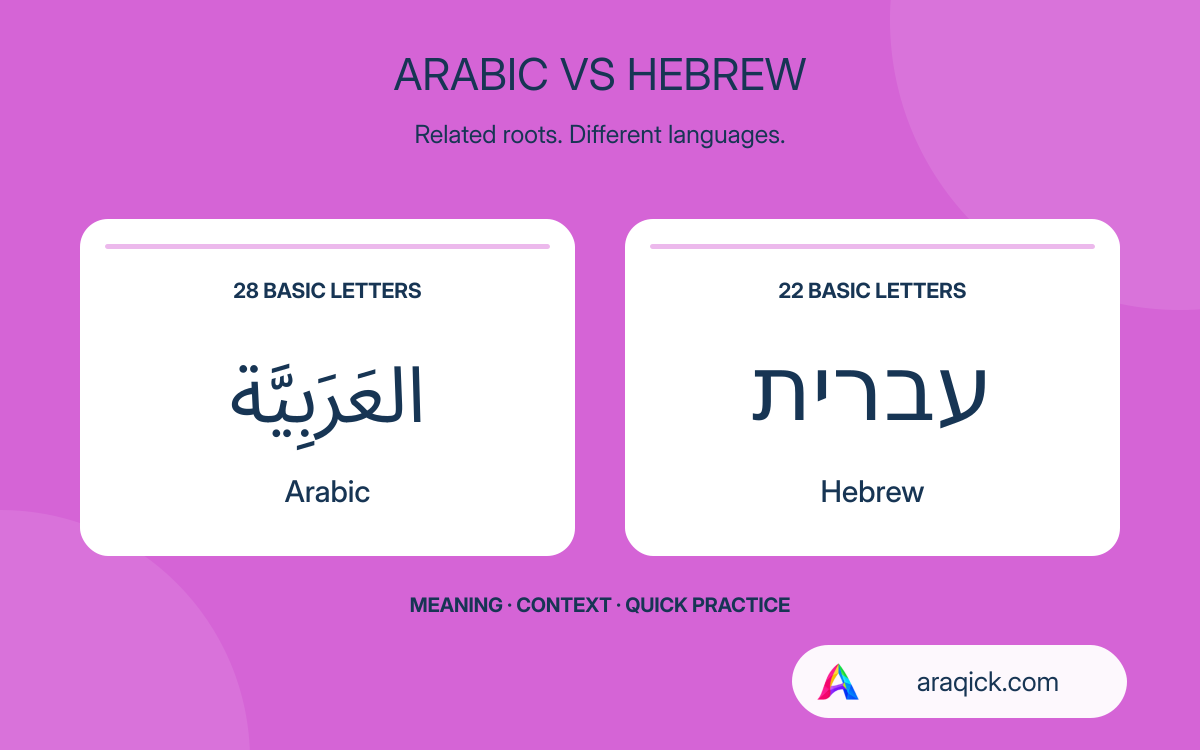
Both scripts run from right to left. The standard teaching counts are 28 Arabic letters and 22 Hebrew letters. Arabic normally joins letters within a word, with shapes influenced by position. Hebrew letters normally remain separate, including in its everyday handwriting style.
Hebrew has special word-final forms for five letters. These are positional forms, not five extra alphabet letters. Arabic and Hebrew names such as alif and alef can hint at historical connections, but a beginner still needs to learn each script directly.
03Do they write vowels?
Yes, but not in the same way as English. Arabic uses letters for long vowels and optional marks for short vowels. Hebrew uses some letters as vowel clues and a pointing system called niqqud. Many ordinary texts omit much of this marking.
The spoken languages still have vowels when marks are absent. Readers use familiar vocabulary and sentence context to resolve the written form. Start with supported examples in each language instead of assuming that every unmarked word has one possible pronunciation.
04What does a shared root look like?
Both languages build many words by combining consonantal roots with patterns. Compare Arabic كَتَبَ (kataba) and Hebrew כתב (katav), both meaning “he wrote.” The traditional root is K–T–B: Arabic ك ت ب and Hebrew כ ת ב.
The final Hebrew letter is pronounced v in katav, which explains why the reading aid does not look exactly like K–T–B. Root correspondence gives a connection; it does not guarantee identical vowels, endings or meanings for every derived word.
05Which grammar features are familiar?
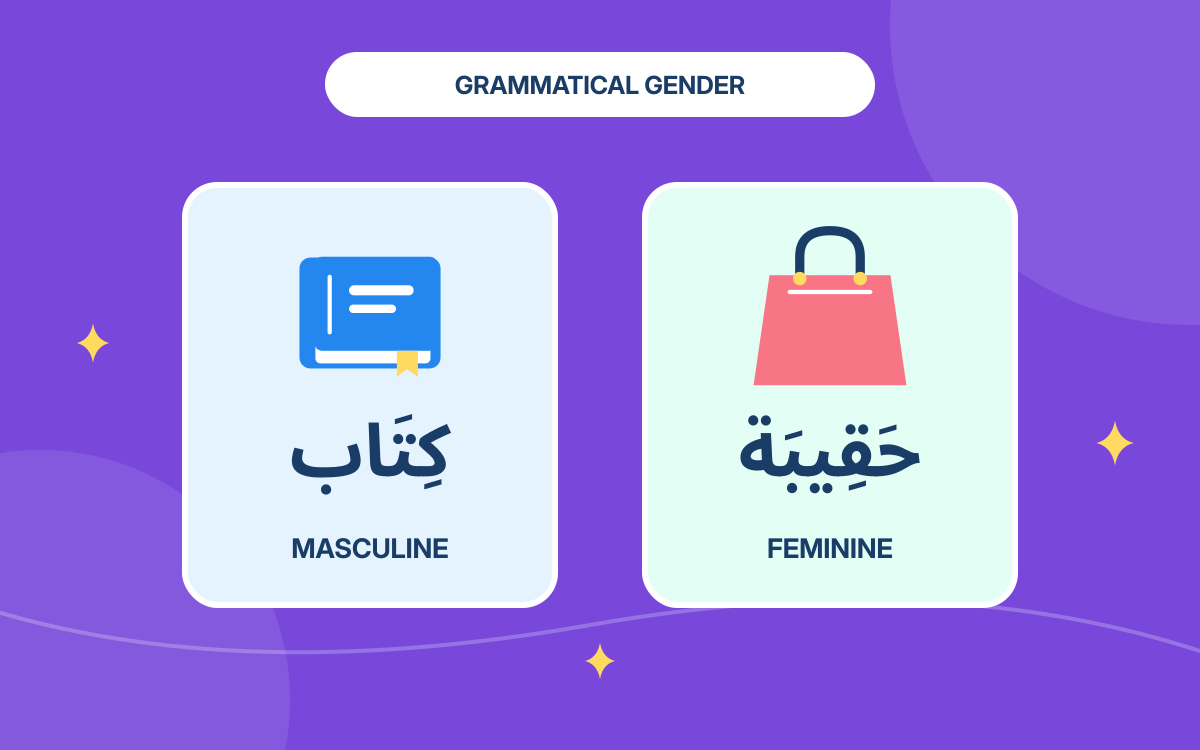
Both languages distinguish masculine and feminine and use agreement between nouns and their descriptions. Both also attach a definite article: Arabic al- and Hebrew ha-. For “the house,” compare الْبَيْت (albayt) with הבית (habayit).
The systems still differ. MSA has a productive dual for two things; Modern Hebrew retains a more limited dual, especially in certain established categories. MSA also teaches noun case endings that do not transfer into ordinary Modern Hebrew. Learn each full construction instead of replacing words inside an Arabic sentence.
06Can speakers understand each other?
Some related words are easy to notice. Arabic سَلَام (salaam) and Hebrew שלום (shalom) connect around the meaning “peace.” Arabic بَيْت (bayt) and Hebrew בית (bayit) mean “house.” Such pairs are useful bridges.
A bridge is not complete comprehension. Many common words, pronunciations and grammatical forms differ. Understanding also depends on prior study, contact and context. Recognising two related words in a sentence does not establish that you understand the message or its tone.
07How should I use the comparison?
Keep a small comparison notebook with four columns: Arabic, Hebrew, reading aid and meaning. Add the variety and a short example when a word has more than one use. Use reliable audio for each language, since English-letter reading aids cannot represent every sound precisely.
For Arabic practice, explore the alphabet chart, verb roots, noun gender and reading without vowel marks. Notice a shared feature, check the target-language form, and practise it in its own sentence.
What to remember
- Arabic and Hebrew are different Semitic languages; this guide compares MSA with Modern Hebrew.
- Both write from right to left, but their alphabets and letter behaviour differ.
- Shared roots and related words help recognition; grammar, pronunciation and complete messages still need separate study.
Your reference shelf
Open a guide whenever you need it.
MSA and Modern Hebrew at a glanceScript and grammar comparisons, with the language varieties kept explicit.
| Feature | Modern Standard Arabic | Modern Hebrew |
|---|---|---|
| Language family | Semitic | Semitic |
| Basic alphabet count | 28 | 22 |
| Main text direction | Right to left | Right to left |
| Joining behaviour | Most letters join within words; six letters stop the onward join | Letters normally remain separate |
| Positional forms | Forms depend on letter position and connection | Five letters have special word-final forms |
| Vowel support | Long-vowel letters and optional short-vowel marks | Vowel letters and optional niqqud |
| Definite article | al- | ha- in the examples here |
| Grammatical gender | Masculine and feminine | Masculine and feminine |
| Dual | Productive forms for two | Limited to particular established categories |
| Useful neutral verbal orders | Subject–verb–object and verb–subject–object | Usually subject–verb–object; other orders occur |
| MSA-style noun case endings | Part of the formal grammar | No comparable productive ordinary noun-case ending system |
These are beginner comparisons rather than complete grammatical descriptions. Spoken Arabic varieties differ from MSA, and Hebrew pronunciation varies among speakers.
Three useful word and root comparisonsArabic with vowel marks; Hebrew in ordinary unpointed spelling; reading aids are approximate.
| Meaning | MSA | Modern Hebrew | What to notice |
|---|---|---|---|
| Peace | سَلَام · salaam | שלום · shalom | Related words with different consonant sounds and vowels. Their greeting uses also depend on context. |
| House | بَيْت · bayt | בית · bayit | A shared meaning does not require an identical spoken form. |
| The house | الْبَيْت · albayt | הבית · habayit | Each language attaches its own article. |
| He wrote | كَتَبَ · kataba | כתב · katav | The traditional K–T–B root is recognisable through a pronunciation difference. |
Arabic examples use simple pause-style reading aids. Hebrew words are left unpointed here; use the stated reading aid and checked audio rather than treating unpointed spelling as a complete pronunciation guide.
Keep the helpful connection, check the differenceA short routine for making a comparison useful in real learning.
| Step | Try this | Check |
|---|---|---|
| Identify | Label the Arabic model MSA and the Hebrew model Modern Hebrew | Are you comparing equivalent varieties and contexts? |
| Recognise | Find bayt and bayit in their own scripts | Can you identify both without relying only on English letters? |
| Listen | Hear a reliable example from each language | Which sounds and vowels actually differ? |
| Build | Use each word inside a checked phrase from its own language | Have you kept its article, endings and agreement? |
| Recall | Cover one column and retrieve the target form | Did recognition turn into accurate recall? |
A root is a guide to word relationships. Use a dictionary and context to confirm the meaning of a new word instead of translating it from a root label alone.
Sources & further learning
References for the language explanations and learning guidance.
- Academy of the Hebrew Language: overview, roots, vowels, gender and dual
- Northwestern University: the Hebrew alphabet and its five final forms
- Northwestern University: the Arabic alphabet
- Itamar Kastner: roots and templates in Modern Hebrew, author manuscript
- University of Iowa, Robert R. Cargill: Hebrew bayit, house
- Hebrew College: related Hebrew and Arabic words and meanings
- University of Pennsylvania Libraries: the Hebrew definite article
- Research study: agrammatic comprehension and basic Modern Hebrew word order
- University of Washington: comparative Hebrew and Arabic morphology, case and definiteness