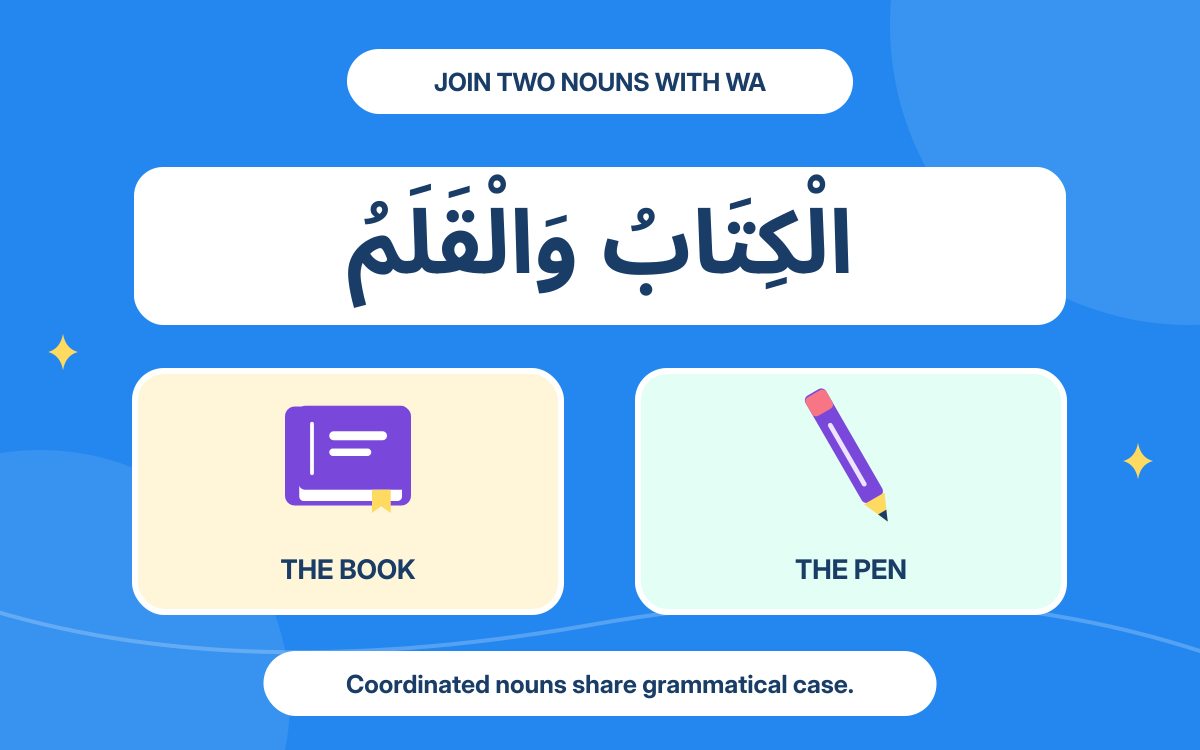
A book and a pen can share a place, an action or a purpose. Arabic joins them with wa, meaning “and.” When wa coordinates two nouns, the second shares the first noun’s grammatical case. Find their job before choosing the endings.
01Join two nouns in the same role
الْكِتَابُ وَالْقَلَمُ عَلَى الْمَكْتَبِ
alkitabu walqalamu ala lmaktabi
The book and the pen are on the desk.
The book begins the topic; the pen is coordinated with it. Both nouns are nominative, so these regular singular forms end in u. Write وَ attached to the following word: walqalamu, “and the pen.” Wa itself does not mean “nominative.”
02Give joined objects the accusative
أَخَذْتُ الْكِتَابَ وَالْقَلَمَ
akhadhtu lkitaba walqalama
I took the book and the pen.
Here the book receives the action, so alkitaba is a direct object in the accusative case. The pen shares that role through wa and is accusative too: walqalama.
The same two objects now have a endings instead of u. Their spelling and meaning stay familiar, but their sentence role has changed. Start with “What did I take?” to find the pair, then choose the case.
03Let a preposition cover the pair
كَتَبْتُ فِي الْكِتَابِ وَالدَّفْتَرِ
katabtu fi lkitabi waddaftari
I wrote in the book and the notebook.
Fi makes alkitabi genitive. The notebook is coordinated with the book and shares its genitive case: waddaftari. Both locations belong under “in,” even though fi appears only once.
You could repeat the preposition to say “in the book and in the notebook.” It is not required in this coordinated pattern. Our reading labels keep the formal endings and show the doubled d heard in waddaftari.
04Match the case, not just the last vowel
لِلْمُعَلِّمِ وَالطَّالِبَيْنِ
lilmuallimi wattalibayni
For the teacher and the two students
The teacher and the two students are both genitive here. The regular singular teacher shows kasrah. The dual students show the genitive through ya in the ending ayni.
Coordination shares grammatical case, but each noun uses its own case sign. Do not force a dual, a sound plural or another special noun pattern to copy the singular noun’s ending. First identify the noun pattern, then apply the shared case.
05Check what wa actually joins
الْكِتَابُ فِي الْحَقِيبَةِ وَالْقَلَمُ عَلَى الْمَكْتَبِ
alkitabu fi lhaqibati walqalamu ala lmaktabi
The book is in the bag, and the pen is on the desk.
Wa now joins two complete statements. Alqalamu starts the second statement; it does not copy the genitive ending of the nearby word alhaqibati.
Ask whether wa joins nouns within one role or introduces another clause. Our case rule applies to coordinated nouns, not automatically to whichever words happen to stand on either side of every wa.
What to remember
- A noun coordinated with another noun shares its grammatical case.
- Shared case can appear through different signs, such as kasrah for a singular and ya for a dual.
- Identify what wa joins before applying the rule; it can also connect whole statements.
Your reference shelf
Open a guide whenever you need it.
Follow the role through three casesReview coordination terms, endings and the scope of wa
| Case | Joined nouns | Example setting |
|---|---|---|
| Nominative | الْكِتَابُ وَالْقَلَمُ | The book and pen form the topic. |
| Accusative | الْكِتَابَ وَالْقَلَمَ | I took both objects. |
| Genitive | الْكِتَابِ وَالْقَلَمِ | I looked at both objects after إِلَى. |
The conjunction is حَرْفُ عَطْفٍ. The first noun is the مَعْطُوفٌ عَلَيْهِ; the noun joined to it is the مَعْطُوفٌ. These labels describe the connection, while nominative, accusative and genitive describe case.
Other coordinating particles have their own meanings and conditions. This guide practises wa meaning “and.” Wa also has other grammatical uses, so identifying a written و alone does not prove that two adjacent nouns are coordinated.
The full readings retain case endings for study. A pause can change the spoken ending without changing the noun’s case. Connected walqalamu omits the starting vowel of the definite article; waddaftari also reflects the sun-letter doubling.
Sources & further learning
References for the language explanations and learning guidance.