When you want someone to choose one book from several, ask “which?” Arabic uses ayy, but its final vowel changes with its role in the question. The noun after it has a different job. Keeping those two jobs separate makes ayyu, ayya and ayyi much easier to understand.
01Ask for a choice
أَيُّ كِتَابٍ جَدِيدٌ؟
ayyu kitabin jadidun
Which book is new?
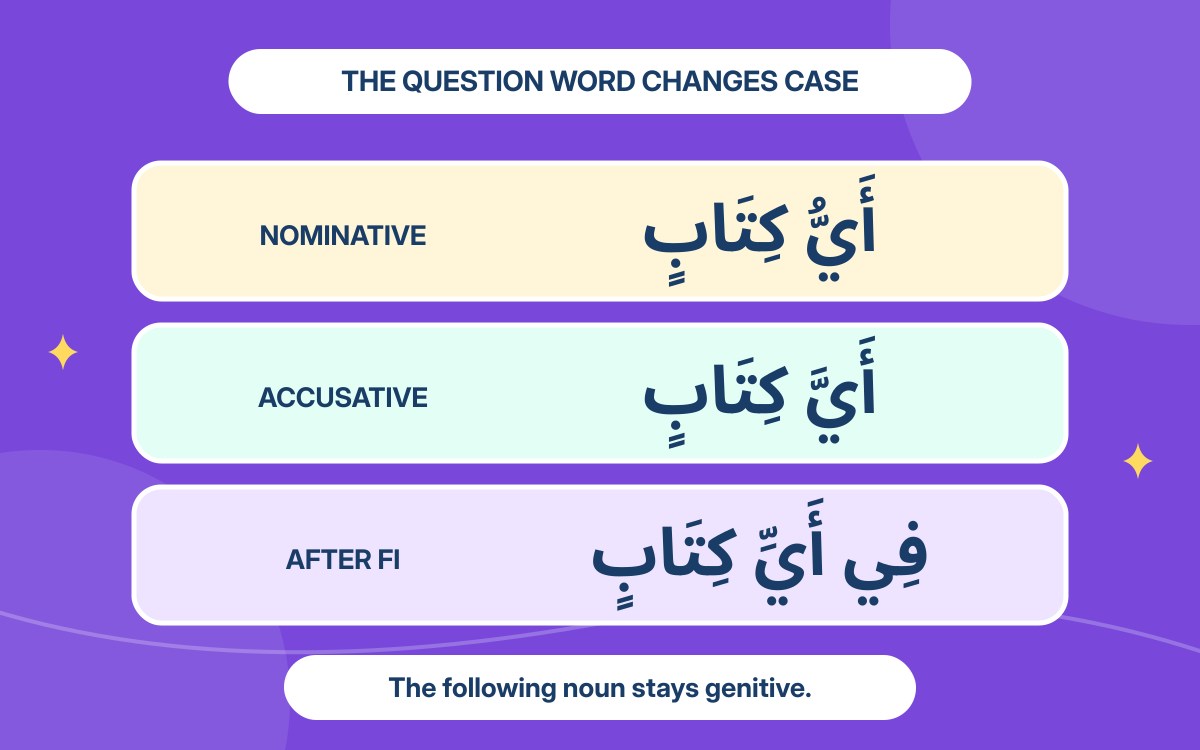
Ayy asks you to identify a choice. Here, ayyu kitabin is the subject and jadidun says “new.” Ayyu is nominative; kitabin is genitive. The words work together, but they do not copy each other’s ending.
02Keep the following noun genitive
In this pattern, ayy is the first term of an idafa and the following noun is its second term. That is why كِتَابٍ keeps its genitive ending. An idafa can express a relationship beyond ownership; “which book” is one example.
أَيُّ قَلَمٍ جَدِيدٌ؟
ayyu qalamin jadidun
Which pen is new?
Replacing “book” with “pen” changes the vocabulary, not the construction. Both nouns are ordinary singular indefinite nouns here, so their genitive ending is in. Ayy itself has no tanween in this construction.
03Use ayya for a direct object
أَيَّ كِتَابٍ فَتَحْتَ؟
ayya kitabin fatahta
Which book did you open?
The book receives the action of opening. Ayy is therefore a direct object and becomes accusative: ayya. Kitabin stays genitive as the second term of the idafa. Do not change both words to an accusative ending.
Fatahta addresses one male listener. You can ask a female listener أَيَّ كِتَابٍ فَتَحْتِ؟ (ayya kitabin fatahti). Changing the listener changes the verb ending; it does not change the jobs of ayya and kitabin.
04Use ayyi after a preposition
فِي أَيِّ غُرْفَةٍ أَنْتَ؟
fi ayyi ghurfatin anta
In which room are you?
Fi, “in,” governs the word immediately after it. Ayy therefore becomes genitive: ayyi. Ghurfatin is also genitive, but because it follows ayy in an idafa. There are two genitive words for two different grammatical reasons.
The question begins with fi ayyi, not ayyu fi. Keep the preposition with the phrase it introduces. Ghurfa means “room”; the final taa marbuta is pronounced t in the full ending ghurfatin.
05Check each word’s job
First decide what the question asks about: the subject, an object receiving an action, or something introduced by a preposition. Then choose ayyu, ayya or ayyi. Finally check the noun that completes the phrase.
These are full formal readings. The doubled y in ayy reflects the shaddah on يّ. Unlike question words with a fixed form, such as مَنْ (man, “who”), ayy can change its ending. We are practising ayy with an explicit following noun; other constructions with ayy have their own details.
What to remember
- Use ayyu for the subject in our first question, ayya for a direct object and ayyi after a preposition.
- The noun completing this ayy construction is genitive, even when ayy is not.
- Choose each ending from its own grammatical job.
Your reference shelf
Open a guide whenever you need it.
Three cases of ayyReview the same book noun after three forms of which
| Role of ayy | Phrase | Full reading |
|---|---|---|
| Nominative | أَيُّ كِتَابٍ | ayyu kitabin |
| Accusative | أَيَّ كِتَابٍ | ayya kitabin |
| Genitive after fi | فِي أَيِّ كِتَابٍ | fi ayyi kitabin |
Our examples use an indefinite noun after ayy. The genitive relationship does not mean that every possible following noun must show tanween: definite nouns and other noun types have their own endings. Ayy also appears in constructions beyond these simple questions.
Sources & further learning
References for the language explanations and learning guidance.