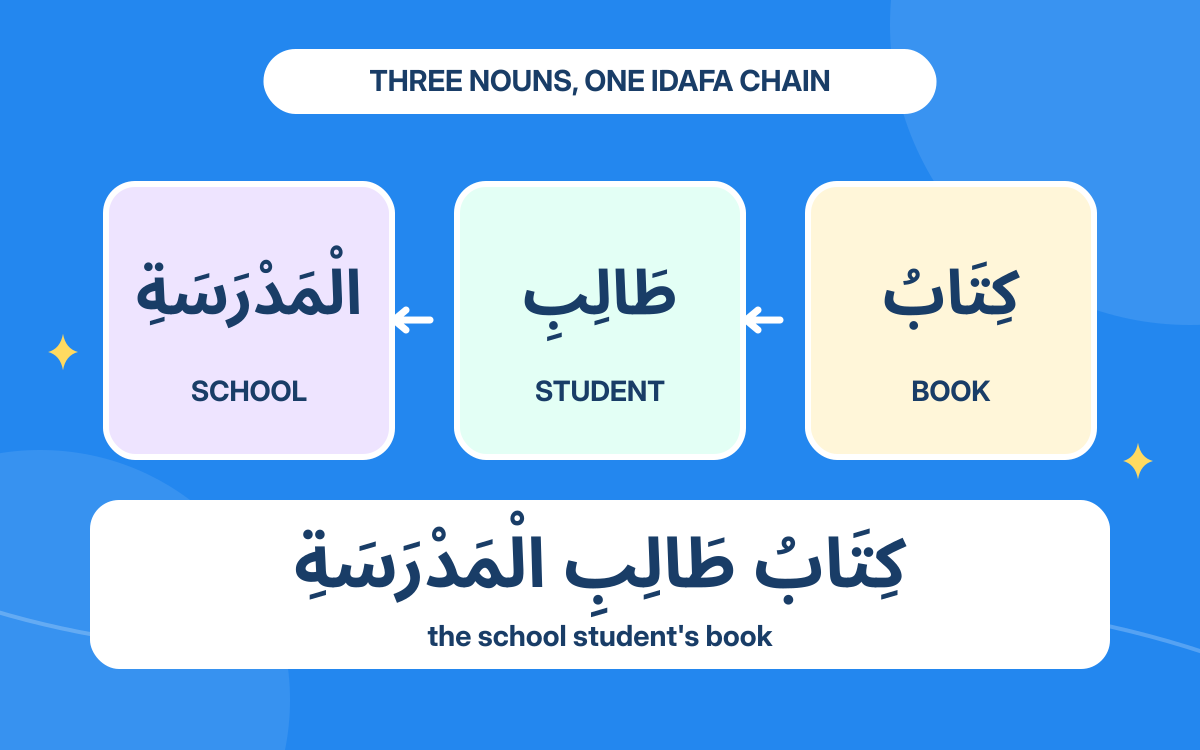
An idafa can link more than two nouns. “The school student’s book” connects a book to a student, then the student to a school. The middle noun has two jobs at once. Learn that link and a longer expression becomes a sequence of familiar two-noun relationships.
01Extend one relationship with another
Start with a book belonging to a student, then identify that student through the school. Keep the Arabic order: book → student → school. No separate word meaning “of” goes between them.
كِتَابُ طَالِبِ الْمَدْرَسَةِ
kitabu talibi lmadrasati
The school student’s book
Book is the first noun, student is the middle noun and school is the final noun. The phrase names a book; it does not say that the student is reading it.
02Give the middle noun two jobs
The middle noun is mudaf ilayh to the noun before it and mudaf to the noun after it. Therefore, it is genitive because it follows the first noun, and it has neither ال nor tanween because it heads the next idafa.
طَالِبِ الْمَدْرَسَةِ
talibi lmadrasati
The school’s student
In the complete chain, talibi completes “the student’s book” while also beginning “the school’s student.” Use talibi, not attalibi or talibin, in that middle position. The final noun completes the second link.
03Let only the first noun follow the sentence role
Every noun after the first is genitive. The first noun takes its case from the surrounding sentence. With these regular singular nouns, compare u, a and i on kitab while talibi and almadrasati remain genitive.
هَذَا كِتَابُ طَالِبِ الْمَدْرَسَةِ
hadha kitabu talibi lmadrasati
This is the school student’s book.
قَرَأْتُ كِتَابَ طَالِبِ الْمَدْرَسَةِ
qaratu kitaba talibi lmadrasati
I read the school student’s book.
فِي كِتَابِ طَالِبِ الْمَدْرَسَةِ
fi kitabi talibi lmadrasati
In the school student’s book
04Read the last noun to check definiteness
In this basic chain, every noun except the last is mudaf: none of those nouns takes ال or tanween. The final noun determines whether the whole chain is definite or indefinite.
كِتَابُ طَالِبِ مَدْرَسَةٍ
kitabu talibi madrasatin
A book belonging to a student of a school
Madrasatin is indefinite, so this chain is indefinite. Almadrasati identifies the school, making the earlier chain definite. Only the final noun may carry ال or tanween here; it does not have to carry either. A proper name can also make a chain definite.
05Check each neighbouring pair
Read the final pair first: talibi lmadrasati identifies the school’s student. Then connect kitab to that student. This helps you translate the whole relationship naturally without reversing the Arabic words.
كِتَابُ طَالِبِ الْمَدْرَسَةِ
kitabu talibi lmadrasati
Book → the school’s student
Finally, check that each pair stays together and that only the first noun changes for a new sentence role. These examples retain formal connected endings. At a pause, the last short vowel is normally dropped; the plain reading aids simplify Arabic sounds and vowel length.
What to remember
- Each middle noun is mudaf ilayh to what precedes it and mudaf to what follows it.
- The first noun follows its sentence role; every later noun in the chain is genitive.
- In a basic noun chain, non-final nouns have neither ال nor tanween, and the final noun determines definiteness.
Your reference shelf
Open a guide whenever you need it.
Three nouns, two idafa linksReview the roles and the Part 1 mosque example
For كِتَابُ طَالِبِ الْمَدْرَسَةِ, check these roles:
- Kitab: mudaf to talib; its case follows the sentence.
- Talib: mudaf ilayh to kitab and mudaf to almadrasah; it is genitive and has no ال or tanween.
- Almadrasah: final mudaf ilayh; it is genitive and makes this chain definite.
Another three-noun chain
مَسْجِدُ رَسُولِ اللَّهِ
masjidu rasuli llahi
The mosque of the Messenger of Allah
Rasuli links the mosque to the messenger and the messenger to Allah. It is both mudaf ilayh and mudaf. These lessons cover basic noun-to-noun chains; advanced types of idafa need further rules. Genitive is a grammatical case, not a promise that every possible noun ends in i.
Sources & further learning
References for the language explanations and learning guidance.