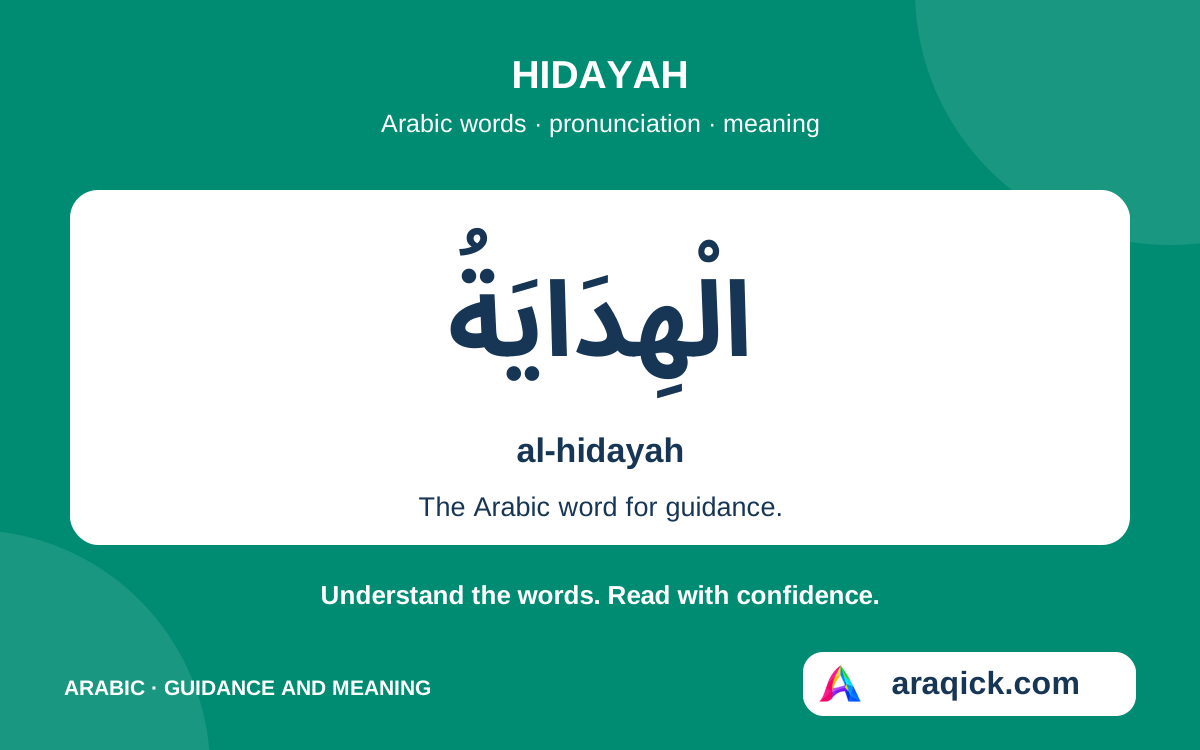
Hidayah, هِدَايَةٌ, means guidance in Arabic. It belongs to the root ه د ي, h-d-y, also found in hadaa, “he guided,” and yahdee, “he guides.” In Islamic discussions hidayah often means guidance toward truth and faith; related forms also describe finding a physical way.
01Hidayah names guidance, not the person guiding
Hidayah is a noun for guidance. It names the action or concept rather than a guide, a route or the person receiving direction. In an Islamic conversation, the surrounding words often indicate spiritual guidance. That familiar religious use is central, but it does not make every word in the family refer only to a change of religion.
Write the word هِدَايَةٌ beside its meaning before adding related vocabulary. Read it hi-daa-yah at a pause, with short hi, long daa and a consonant y before the last vowel. English spellings hidaya and hidayah usually represent the same Arabic noun.
02Hadaa and yahdee show a weak final root letter
The verb هَدَى, hadaa, means “he guided.” The present form يَهْدِي, yahdee, means “he guides.” The final letter in the past is alif maqsura: it looks like an undotted yaa but represents long aa. In the present, the final yaa represents long ee. The root’s final consonant is yaa.
This changing spelling is normal in weak verbs. Do not pronounce the past as hadi merely because its final shape resembles yaa. Keep both verb forms beside the root. Our Arabic verb roots guide explains why dictionary forms sometimes conceal the visible shape of a root letter.
03Huda is another important noun for guidance
The Quran frequently uses هُدًى, huda, for guidance. Quran 2:2 describes the Book using this noun. Huda and hidayah belong to the same family, but they are different Arabic forms. An English translation saying “guidance” does not tell you which noun or verb appears in the original.
When read with its written tanwin in ordinary connected grammar, هُدًى is hudan; at a formal pause it is hudaa, with long aa. Hidayah instead ends in taa marbutah. Compare the Arabic letters rather than assuming that the shorter English spelling huda means a short final vowel.
04Ihdinaa is a request for guidance
The opening word of Quran 1:6 is اِهْدِنَا, ihdinaa: “Guide us.” The command-shaped verb functions as a supplication addressed to Allah. The suffix naa identifies the people seeking guidance. This short expression is not the noun hidayah with an extra ending; it is a different grammatical form from the same root.
The complete verse continues with the straight path. For learning, first separate the request, its recipient and what is requested. Our beginner Quranic Arabic study plan uses this kind of short, meaningful analysis instead of expecting a transliteration alone to explain an entire verse.
05A physical direction and spiritual guidance share a family
Quran 6:97 uses a related verb when describing navigating by stars on land and sea. This is a concrete context: finding a way through darkness. In Quran 28:56, the discussion concerns Allah’s guidance and the Prophet’s inability to bring about that outcome for everyone he loves. These settings give the verb different emphasis.
Quran 42:52 also describes the Prophet leading toward a straight path. Reading the passages together prevents the mistaken conclusion that Arabic never describes a human being as guiding. Direction, conveying a message and someone’s inward response are not automatically identical just because the English translation uses “guide.”
06Distinguish the guide from the guided person
The definite form الْهَادِي, al-haadee at a pause, means the guide or the one who guides. By contrast, مُهْتَدٍ, muhtadin in its connected indefinite form, describes someone guided or rightly guided. Its pause reading is muhtad. The added letters and pattern change the role even though the root remains h-d-y.
For a useful review, sort the family into a concept, an action, a request and a person-description. Then identify the subject in one short passage. Consult translation, transliteration and tafsir when an English gloss leaves the intended context unclear. Careful form recognition makes the wider explanation easier to follow.
What to remember
- Hidayah means guidance and belongs to the h-d-y root.
- Hadaa, yahdee and ihdinaa are verbs; huda and hidayah are nouns.
- The subject, word pattern and context distinguish different kinds of guiding.
Your reference shelf
Open a guide whenever you need it.
Guidance: forms worth recognisingPause and connected readings are labelled to avoid confusing the final weak letters.
| Arabic | Plain-letter reading | Meaning and role |
|---|---|---|
| هِدَايَةٌ | hidaayah at a pause | Noun: guidance |
| هُدًى | hudan connected; hudaa at a pause | Noun: guidance |
| هَدَى | hadaa | Past verb: he guided |
| يَهْدِي | yahdee | Present verb: he guides |
| اِهْدِنَا | ihdinaa | Request: guide us |
| الْهَادِي | al-haadee at a pause | The guide; the one who guides |
| مُهْتَدٍ | muhtadin connected; muhtad at a pause | Someone guided or rightly guided |
| الْمُهْتَدِي | al-muhtadee at a pause | The guided person |
Read each guidance passage in contextThese are brief descriptions of the passages, rather than replacement translations.
| Passage | What to notice | Learning focus |
|---|---|---|
| Quran 1:6 | A request addressed to Allah | Ihdinaa is a verb plus “us” |
| Quran 2:2 | The Book described as guidance | Huda is a noun |
| Quran 6:97 | Finding a way by stars | Related verbs can refer to physical navigation |
| Quran 28:56 | Allah’s guidance and its outcome | The subject and intended sense matter |
| Quran 42:52 | The Prophet leading toward a straight path | A human can be described as guiding in context |
Sources & further learning
References for the language explanations and learning guidance.